
This article covers the following
- About the Feedback register settings
- About the Feedback register menus
- Configuring Feedback Register Dropdown Menus
Permissions: Access to these settings requires the Admin permission 'Edit system settings'. Learn more about Administration permissions.
About the Feedback Register settings
The Feedback register settings provides the ability to activate various features that enhance the functionality of the Feedback register. These features are detailed in the table below.
Important note: When these features are selected, they are activated immediately. Please carefully consider the potential impact on your organisation before enabling them.
| Enable two-level category type menu | This feature is hard coded to enable a 2-tier cascading menu for feedback categories. |
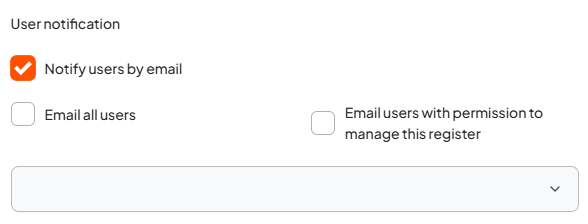
| Enable controls to 'bulk send' notifications to all users and/or to all approval licence holders |
This setting allows you to notify a group of users in bulk. This setting reveals 2 options:
Note: This setting does not change or extend a user’s existing viewing permissions. It only sends them a notification about the feedback. If a user is notified but does not have permission to view the feedback, they will not be able to access its details. |
| Enable 'Related service or program' field | This feature enables you to add an additional field to the Feedback details form to select which ‘related service or program’ the feedback relates to. |
| Enable information requests | This feature enables you to extend the Feedback register to manage information requests. When activated a new component on the Feedback details form will to recall specific details regarding the information request. Learn more |
| Set 'Person/s involved' component to mandatory | This setting makes the Person/s involved component mandatory, so users must record the details of individuals involved in the feedback or complaint when submitting the Feedback. |
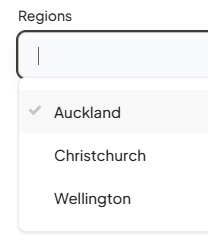
| Related region |
This feature adds a dropdown menu to the Feedback details form, enabling users to select the geographic region to which the feedback or complaint relates.. You can add your regions via the 'Regions' setup list under the Feedback register menus.
|
| Complaints determination and response date | This feature enables an option to record if a complaint meets the organisation's definition of a formal complaint. It presents at the manage and close stages of the workflow. It also displays a field for recording the date of the final response to the complainant. |
| Hide identified issues and improvement component at the reporting stage | This setting hides the Identified issues and improvements component at the time the feedback is reported. This helps prevent unnecessary improvements being raised by the initial reporter. |
| Default viewing permission for complaints | This feature enables you to set by default which teams can view complaints. |
|
External feedback notification |
This feature only displays if the Feedback register integration API has been activated. The Feedback register integration API supports an integration with your website or other platforms enabling feedback to be reported through another platform. When feedback is reported through another platform, the feedback is added as a draft item in the Logiqc Feedback register and staff who are selected in this field are notified. Learn more. |
| Email address |
If you have a team email for receiving complaints, you can add the team email here. This is an optional field. When feedback is reported through another platform, a notification will be sent to this email as well as to the email accounts of those who have been selected in the field ‘Users/positions’. |
About the Feedback Register menus
The following menus appear in the Feedback details form. For some of these menus, Logiqc has added example content based on your vertical. Others have been left blank as they are specific to your organisation. All these menus can be modified by your organisation.
|
Accommodation |
If your organisation owns or leases accommodation, you may be interested in activating an additional field on the Feedback details form which allows you to code feedback by the respective accommodation to which the feedback relates. This menu allows you to add the address or other unique accommodation identifier. For example, 57 Rose Street, Unit 3/53 Hibiscus Street. |
|
Ethnicity |
This menu appears in the Persons involved component of the Incident details form. With this feature, you can code the ethnicity of the individuals involved. The menu options presented for Australian based organisations are those defined in the Australian Standard Classification of Cultural and Ethnic Groups and the menu options presented for New Zealand based organisations are those defined in Ethnicity New Zealand Standard Classification 2005 V2.0.0. Instances of 'nec' refer to "Not Elsewhere Classified". Instances of 'nfd' refer to "Not Further Defined". |
|
Feedback Type |
This menu allows you to classify the feedback based on its type, for example: Complaint, Compliment, Client feedback. This is the first menu selected when adding Feedback. |
|
Feedback category |
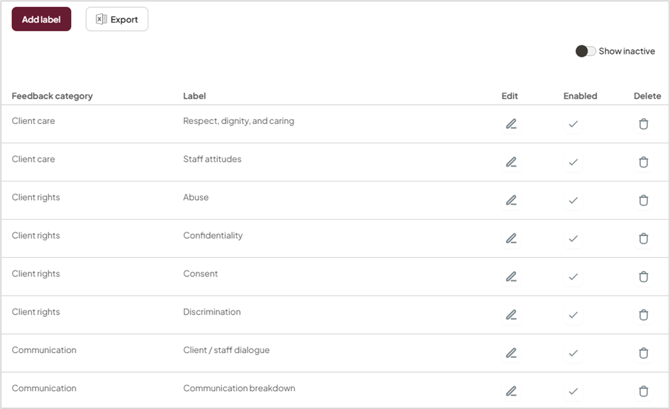
The taxonomy for feedback is presented as a two-tier menu, consisting of a primary category (Feedback category) and a secondary category (Feedback sub-category). This hierarchical structure provides you with a greater level of detail when assigning a Feedback type. The primary feedback category represents the main types of feedback your organisation will receive, such as client rights, communication. On the other hand, the sub-category comprises the sub-categories within each primary Feedback category. For example, under client rights, you can find sub-categories such as abuse, confidentiality, consent, and discrimination. By utilising the Feedback category and sub-category filter in both the register and analytics, you can generate status reports by category and sub-category. |
|
Feedback sub-category |
|
|
Feedback Source |
This menu allows you to classify the feedback based on its source, such as clients, suppliers, or government agency. The ‘feedback source’ codifies the individuals or organisations that have provided feedback, which enables you to filter and analyse feedback received by its ‘source’. |
|
Gender |
This menu appears in the Persons involved component of the Feedback details form and is a mandatory menu. With this feature, you can code the gender of the individuals involved. Note: You can add an N/A option if your organisation is not required to record this information. |
|
Information request type |
This menu allows you to categorise information requests by 'request type', such as subpoenaed or FOI request. |
|
Person type |
This menu appears in the Persons involved component of the Feedback details form and is a mandatory menu. This list allows to classify the type of persons related to the feedback or complaint e.g. Staff, Visitor, Contractor, etc. |
|
Region |
This menu allows you to categorise feedback or an information request by its geographic region. This Register menu is the same menu that will display on the Incidents register. |
|
Related service or program |
This menu allows you to categorise feedback or information request based on the specific service or program it pertains to |
Configuring Feedback Register Dropdown Menus
Follow these steps to add, edit, or disable options within your Feedback register menus.
1. Access Administrative Settings
- Enter Admin Mode: Click your account profile icon and select Admin mode.
- Navigate to Register Settings: From the Administrator menu, go to System settings.
- Filter by register setting: In the Settings type dropdown, select Register settings - Feedback.
- Under Register menus, select the specific menu you wish to edit.
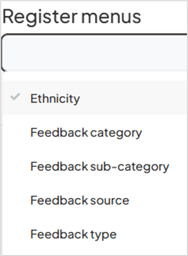
- For standard (single-level) menus, click Add label.
- Type your desired label name and click OK
- Repeat this process for any additional labels needed.
- Important: Click Save, then refresh your browser page to apply the changes to the live Feedback details form
Managing Existing Labels
If you need to remove or recover menu options, use the Enabled column
| Action | Instructions |
| Disable a Label | Uncheck the tick in the Enabled column for that label and click Save. This hides the option from the dropdown menu without deleting its history. |
| View Hidden Labels | Toggle on the Show inactive switch at the top of the menu list to see previously disabled labels. |
| Re-enable a Label | While Show inactive is on, check the tick in the Enabled column and click Save. |
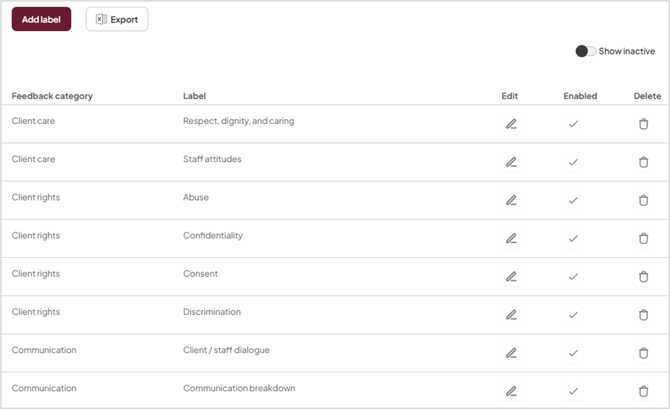
Single level menu
Configuring Multi-Level Menus (Sub-categories)
Use these steps to create a secondary menu (e.g., Feedback Sub-category) that is conditionally linked to a primary menu (e.g., Feedback Category).
1. Select the Sub-category Menu
- Navigate to the Register menus section.
- From the dropdown list, select Feedback sub-category.
2. Link a Sub-category to a Parent Category
- Click Add label.
- Select the Parent Category: In the "Feedback category" field, choose the primary category this sub-option should belong to.
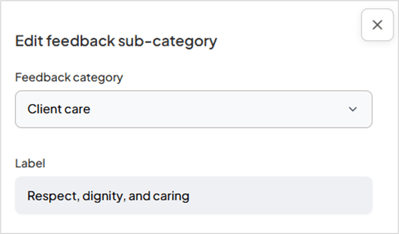
- Enter the Label: Type the name of the sub-category you want to add.
- Click OK.
3. Finalise and Verify
- Repeat: Continue adding labels for all necessary sub-categories.
- Save Changes: Click Save at the bottom of the screen.
- Refresh: Refresh your browser page to sync the changes.
Once saved, the List View will update to display the relationship between the main category and its linked sub-categories, making it easy to audit your menu structure at a glance.
Multi-level menu