
In this article:
Learn how to assess your organisation's compliance with a standard in Logiqc, link the evidence that supports it, and review how that evidence appears in the Evidence Report.
Evidence can be linked directly from the registers in your platform, added through accreditation actions, or built automatically from Logiqc Auditor when audit questions are mapped to cpecific requirements in the Accreditation register.
Evidence is any register item that helps verify how your organisation meets an accreditation requirement. It might be a document, audit result, risk, incident, feedback item, maintenance record, supplier record, or an accreditation action created to close a gap.
| Evidence source | How it supports the requirement |
|---|---|
| Linked register items | Manually link existing register items in your platform, such as documents, risks, incidents, records, or feedback. |
| Linked audit questions | Use Logiqc Auditor to map audit questions to stated requirements, so submitted audit responses, comments, and attachments become live evidence. |
| Accreditation actions | Create assigned work when the requirement is not yet fully met, then track the action through to completion. |
Q: Which registers can I link evidence from?
A: Any register in your platform. Select the register in the Register field, then choose the items to link.
Q: Does audit evidence appear automatically?
A: Yes, when audit questions have been linked to accreditation requirements in Logiqc Auditor and audits using those questions have been submitted.
Q: How do I remove a linked item?
A: Select the trash can next to the item in the evidence list, then save your changes.
Before you start
Check the following:
- The evidence checklist has been published on the Accreditation register.
- You have the permission to work with items in the Accreditation register.
- The evidence items you want to link already exist in their source registers. For automated audit evidence, the relevant audit questions need to be linked to the relevant requirements.
Step 1: Open the requirement
Navigation path
Select the evidence checklist in the menu at the top of the page and go to the second tab. This tab lists the requirements where you can link evidence. The shaded areas are set up by Logiqc and outline the requirements.
Step 2: Describe how you meet the requirement
In the How the requirements are met field, describe how your organisation meets the requirement. This field may contain a pre-populated example. Update it so it reflects your organisation's actual process, evidence, and scope.
Assessment: select the self-assessment rating that best reflects your current position, such as Exceeded, Met, Part met, Not met, or Not applicable.
Evidence and examples: use this area to record any extra context that helps explain the linked evidence.
Step 3: Link evidence items
In the evidence section, select Add to open the Add evidence items dialog.
- In the Register field, select the register that holds the evidence.
- In the Register items field, select the items to link. Type a title or part of a title to search.
- Repeat for each register you want to link evidence from, then select OK.

The Register dropdown lets you choose the source register before selecting the evidence items.
You can also link evidence from the source item's own Related items tab. Select Add new item to create a new register item and link it in one step, or Link items to link an existing one. Choose Accreditation as the register, select the evidence checklist, then select the requirement(s) to link as evidence.
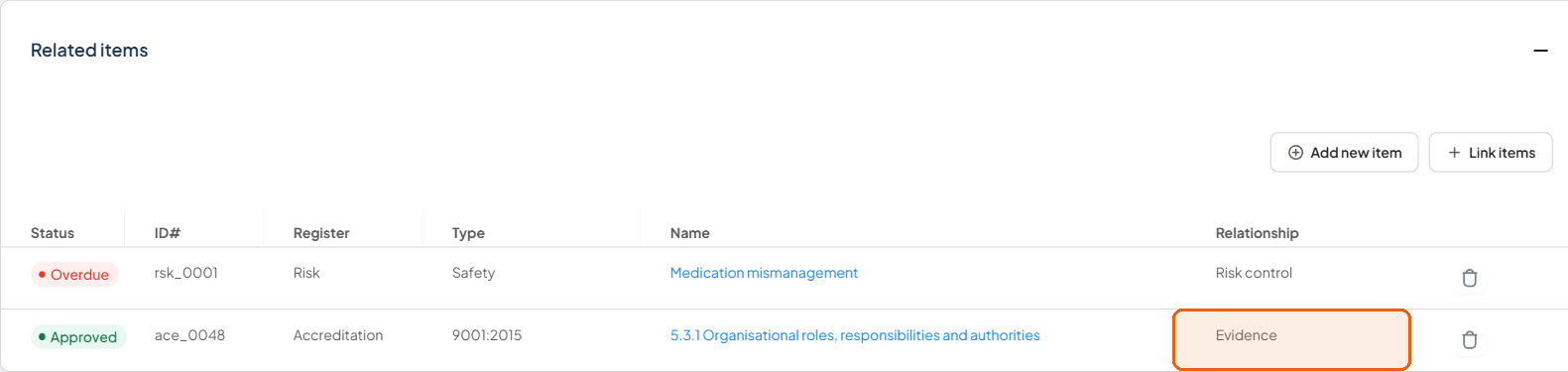
Evidence links made from the Related items tab show Accreditation as the register and Evidence as the relationship.
Items linked this way appear automatically in the requirement's evidence list, so you don't need to add them twice.
Step 4: Include evidence from Logiqc Auditor
If your organisation uses Logiqc Auditor, audit questions can be mapped to specific requirements from the audit template. Once audits using that template are submitted, linked responses, comments, and attachments become live evidence in the Evidence Report.
Map once
Link an audit question to the matching standard, criterion, action, or indicator in the audit template.
Build evidence over time
Each submitted audit adds evidence against the mapped requirement, making coverage gaps easier to see.
Read the article to find out more:
Step 5: Add accreditation actions
If further work is needed to meet the requirement, select Add Action to open the accreditation action details page.
Action: document the work to be completed, such as drafting a policy or updating evidence.
Assign to: select the action officer who will receive and complete the task.
Due date: set when the action needs to be completed.
Status: set the action status so progress can be tracked on the Accreditation action plan tab.
Select OK, and repeat for any further actions. When you save your changes, a task is generated for each action officer.
Step 6: Link related events (optional)
On the parent item in the first tab, use Related events to create a permanent link to the incident types and feedback categories that apply to the standard. This contributes to the Evidence Report by showing how your organisation manages adverse events and responds to feedback.
Step 7: View the Evidence Report
Select View Evidence Report to see how the linked evidence, Auditor evidence, related events, and actions display for the requirement. You can also open the Evidence Report from the Evidence list tab by selecting the link to an assessment requirement.

The Evidence Report brings together your assessment wording, linked evidence, and evidence grouped by source register.
How linked evidence displays
Use the arrows to step through the evidence panels, or click an image to zoom in.

Collapsed
Linked evidence is grouped by register. Select the plus icon to expand a source.

Expanded
Each item shows its blue ID link, status, description, assigned officer, and dates.

Risk register
Evidence from another register appears in its own expandable panel.
Troubleshooting
If the evidence or action does not appear as expected:
"I cannot find the evidence item"
- Check that the item already exists in the source register.
- Select the correct Register in the Add evidence items dialog.
- Search using part of the item title or ID if the list is long.
"Audit evidence is not showing"
- Check that the audit question has been linked to the correct requirement in Logiqc Auditor.
- Confirm that an audit using the linked template has been submitted.
- Open the Evidence Report for the same standard and requirement that the audit question was mapped to.
"The evidence is not showing in the report"
- Confirm the item was added to the evidence list before selecting OK.
- Save your changes on the requirement details page.
- Open the Evidence Report again from the requirement or the Evidence list tab.
What happens next
Evidence is grouped by source
Linked items are organised by register in the Evidence Report, so auditors can see where each piece of evidence came from.
Audit activity can keep adding evidence
When audit questions are mapped through Logiqc Auditor, submitted audit responses continue building evidence against the mapped requirement.
Coverage gaps are easier to spot
You can compare the assessment wording, linked evidence, and actions to see where more evidence or follow-up work is needed.
Reporting becomes simpler
The Evidence Report is ready to review, export, or print when preparing for accreditation reviews and external audits.